
Monastic Sign Language
A 1,000-year-old “silent vocabulary” that let English monks obey their vow of silence while still functioning as a community.

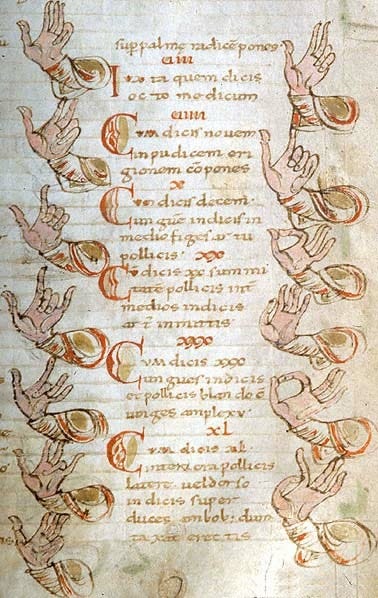
Silence
Some monks practiced silence (more accurately, restraint of speech or taciturnitas) as a core spiritual discipline in Christian monasticism, especially from the early centuries onward in the Benedictine, Cistercian (including Trappist), and Carthusian traditions. Reasons included:
Spiritual focus and contemplation: Minimizing distractions from worldly talk, gossip, or idle chatter, allowing monks to “listen with the ear of the heart” to God, cultivate inner stillness, and pursue prayerful union with the divine.
Avoidance of sin: Drawing directly from Scripture (Proverbs 10:19: “In much speaking you will not escape sin”).
Humility, obedience, and asceticism: Restraint of speech fostered self-discipline, humility, and detachment from self-importance. It emulated the “angelic life” of heaven and supported the broader monastic goals of purity and salvation.
Practical community life: In communal monasteries, silence preserved peace and brotherly love; in stricter eremitical (solitary) traditions like the Carthusians, it enabled deep solitude.1
Monasteriales Indicia
Monasteriales Indicia (Latin for “monastic signs” or “indications”) is the name of a short Old English text from the mid-11th century that records a system of 127 hand gestures used by Anglo-Saxon Benedictine monks. It is the earliest known English example of a monastic sign language — a practical vocabulary of signs that allowed monks to communicate basic needs during the many hours when the Rule of St Benedict (and the English Regularis Concordia) required silence.
The text survives in Cotton Tiberius A.iii, a large composite manuscript from Christ Church, Canterbury (British Library). It occupies folios 97v–101v and sits between copies of the Regularis Concordia and the Rule of St Benedict. The signs were therefore intended for the reformed Benedictine monasteries established or revived in late Anglo-Saxon England (especially after the 10th-century monastic revival under Dunstan, Æthelwold and Oswald).2
A modern English translation of Monasteriales Indicia is at the Fisheaters site.
For example:
Books
These are the signs of the books that one shall use at the divine service in church.
When you would like a gradual, move your right hand and crook your thumb, for this is how it is denoted.
If you would like a sacramentary, then move your hand and make a motion as if you were blessing.
The sign of the epistolary is for one to move his hand and make the sign of the cross on his forehead with his thumb, because one reads the word of God there as well as on the Gospel-book.
If you would like an oblong book, extend your left hand and move it, then set your right (hand) over your left arm the same distance as the length of the book.3
Other Sources on Monastic Sign Language
Conde-Silvestre, Juan C. “The Code and Context of Monasteriales Indicia: A Semiotic Analysis of Late Anglo-Saxon Monastic Sign Language.” Studia Anglica Posnaniensia 36 (2001): 145–169.
Foys, Martin K. “A Sensual Philology for Anglo-Saxon England.” Postmedieval a journal of medieval cultural studies 5.4 (2014): 456–472.
Stokoe, William C. “Approaching Monastic Sign Language.” Sign language studies 58.1 (1988): 37–47.
Umiker-Sebeok, Donna Jean, and Thomas A Sebeok. Monastic Sign Languages. Reprint 2011. Berlin ; Mouton de Gruyter, 1987.
Bruce SG. Silence and Sign Language in Medieval Monasticism: The Cluniac Tradition, c.900–1200. Cambridge University Press; 2007.
A modern edition and translation was published by Debby Banham in 1991 (Monasteriales Indicia: The Anglo-Saxon Monastic Sign Language, Anglo-Saxon Books).
“Monastic Sign Language” at Fisheaters.
Signs of the books - which are full of signs that represent signs in our brains. A reminder that language is an abstraction that has a certain reality of its own.
Fascinating. Did any of this sign alphabet carry over into modern day sign language used by the deaf?