
Cathedral Archives, Libraries and Collections Association (CALCA)
Gold Medal to David Shaw


Association of English Cathedrals
The Association of English Cathedrals (AEC) represents the 42 Anglican cathedrals in England, along with the royal peculiars of Westminster Abbey and St George's Chapel, Windsor. 1 The AEC is an advocate for these historic institutions, promoting their spiritual, cultural, and communal roles while fostering collaboration among them. The AEC emphasizes that cathedrals are "more than a building"—they are places of worship, heritage sites, and community hubs offering peace, inspiration, and education.2
Status of Cathedral Libraries in England
Cathedral libraries in England form a vital part of the nation's cultural and ecclesiastical heritage, primarily associated with the Church of England. There are approximately 42 Anglican cathedrals in England, many of which maintain libraries and archives dating back to the medieval period.
These collections encompass medieval manuscripts, early printed books, theological works, church history, patristics, and broader subjects like science, medicine, and local history.
The history of cathedral libraries shows that each is unique, an integral part of the cathedral and of great importance to the ecclesiastical historian, liturgiologist, musicologist, student of the humanities, rare book librarian and bibliographer. 3
Cathedral Archives, Libraries & Collections Association
The Cathedral Archives, Libraries & Collections Association (CALCA), promotes preservation and access, oversees these resources across the UK and Ireland, ensures cataloguing, conservation, and public engagement through exhibitions and guidance on topics like data protection and record management.
Notable examples include:
Canterbury Cathedral Archives & Library: Contains 30,000 pre-1900 books and 20,000 modern volumes.
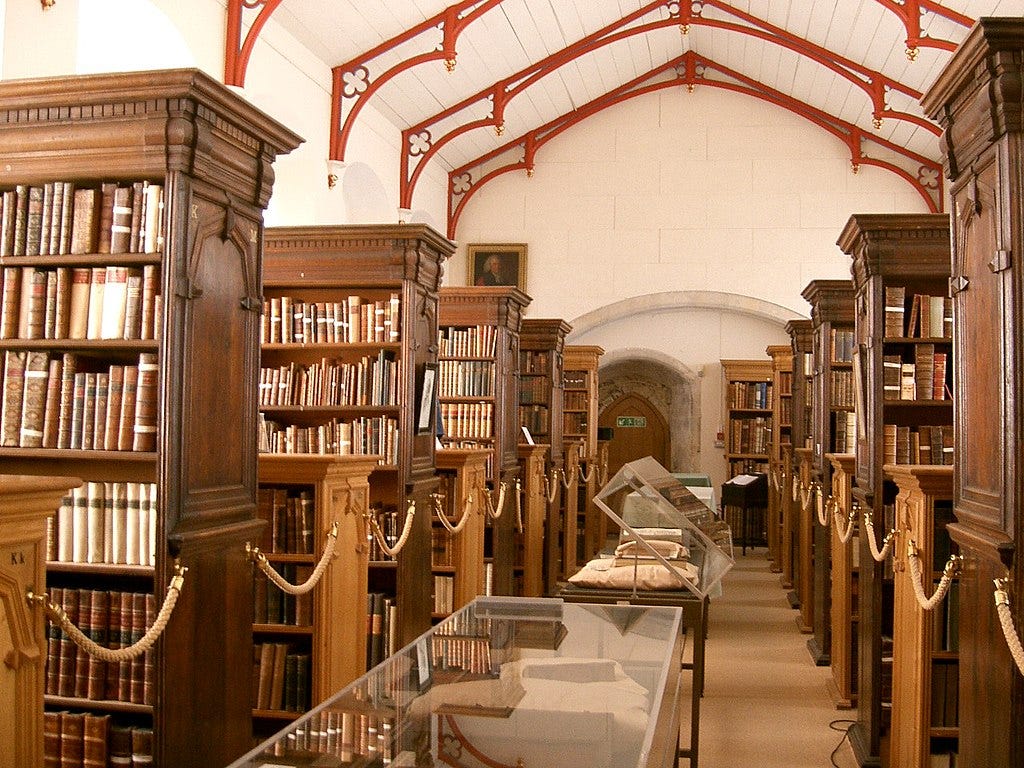
Exeter Cathedral Library and Archives. Holds medieval manuscripts, early printed books, and records from the 10th–21st centuries.
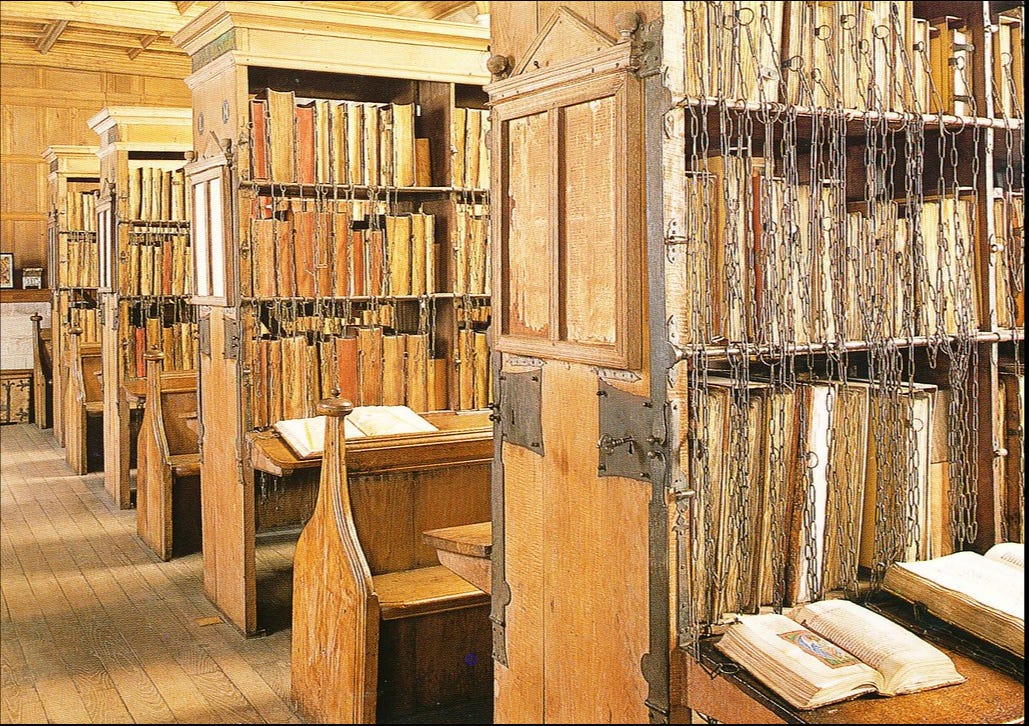
Hereford Cathedral Library. The world's largest surviving chained library (17th century), with 229 medieval manuscripts and 1,200 early printed books, including the Mappa Mundi. 4
St Paul's Cathedral Library: Focuses on theology, church history, and patristics.
Wells Cathedral Library: Mid-15th-century structure with 2,800 volumes (mostly 16th–18th century), including a 1472 Pliny's Naturalis Historiae.5
Gold Medal of the Cathedral Archives, Libraries & Collections Association

The Gold Medal of the Cathedral Archives, Libraries & Collections Association will be awarded in 2025 to Dr. David Shaw6 in recognition of his distinguished services to bibliography, including the Cathedral Libraries Catalogue and his many publications on French and English printing. 7
Cathedral Libraries Catalogue
The Cathedral Libraries Catalogue is a comprehensive project by the Bibliographical Society. 8 It documents over 25,000 pre-1701 books across 37 Anglican cathedrals (excluding some like Lambeth Palace and Westminster Abbey), highlighting their role as repositories of early modern European scholarship. Theology dominates, but the holdings refute the notion that they are limited to divinity, including diverse fields like law, geography, and oriental studies.
It focuses on books printed before 1701, providing detailed records of historical holdings from the mid- to late 20th century. The catalogue serves as a vital resource for scholars studying the history of printing, theology, and intellectual life in early modern Britain, revealing the diverse collections beyond just religious texts.
It highlights the intellectual interests of cathedral dignitaries from the late Middle Ages through the Reformation, Counter-Reformation, and into the 17th century. The introductions are often cited in scholarly discussions of early modern bibliography and library history.9
Association of English Cathedrals. See also:
Francis, L. J., & Lankshear, D. W. (Eds.). 2021). Anglican Cathedrals in Modern Life: The Science of Cathedral Studies. Published by: Palgrave Macmillan (multiple chapters).
Platten, S., & Brown, A. (Eds.). (2023). "Introduction to the special issue on cathedral studies (part 1)." Published in: Journal of Beliefs & Values: Studies in Religion & Education, 44(4), 445–449. Special issue on cathedral studies mentions the AEC in the context of advancing interdisciplinary research on cathedrals' roles in modern society.
Morgan, P. E. (1986). Cathedral librarianship. Journal of Librarianship, 18(3), 153-164;
See also: Hingley S. “Ecclesiastical libraries: libraries for the higher clergy.” In: Mandelbrote G, Manley KA, eds. The Cambridge History of Libraries in Britain and Ireland. Cambridge University Press; 2006:122-133.
Alington, Gabriel. 1996. The Hereford Mappa Mundi. Leominster: Gracewing.
Colchester, L. S. 1987. Wells Cathedral. London: Unwin Hyman.
Shaw previously was honored with DLitt (Degree of Doctor of Letters) in recognition of work as Editor-in-Chief of the Bibliographical Society’s Cathedral Libraries Catalogue project. He is Deputy Chairman, Canterbury Archaeological Trust. His blog focuses on on the history of the book, early music, and the history of Canterbury Cathedral Library and its collections.
Cathedral Libraries Catalogue. (CLC). The Cathedral Libraries Catalogue saw its origins in 1943 when the Bibliographical Society, with support from the Pilgrim’s Trust, employed Miss Margaret Hands to prepare entries for the proposed Catalogue. The first work was done at Worcester Cathedral in March 1944. The subsequent history of the project is told in the Introduction to Volume One of the Catalogue which was published in 1984 and was updated in the Introduction to Volume Two.
Volume One gave a summary listing of all the English-printed and English-language books in the English and Welsh Cathedral libraries printed before 1701, about 26,000 in total, arranged by STC and Wing entry numbers.
Volume Two is a full-scale catalogue of all the books printed outside Great Britain before 1701. There are nearly 26,000 entries, each giving a long short-title entry with author, title, imprint, notes and locations, with page and/or signature collations where available. The data have been stored as MARC records and the typesetting has been done by specially written software which generates cross-reference entries and an Adams-style sequence number for reference. There is a full index of printers, publishers and printing towns, which will be especially valuable for the seventeenth-century books where these essential research tools are still largely lacking.
The popular misconception that Cathedral Libraries contain only theology is forcibly refuted by this catalogue. Theology is of course present: in fact, the catalogue gives a full picture of the range of orthodox and dissident opinion in religion from the late Middles Ages, through the Reformation and Counter Reformation and on into the seventeenth-century controversies presaging the Enlightenment. The same full chronological panorama can be seen for many other fields too: law, history, geography, classical studies, oriental studies, literary and popular texts in all the major and many of the minor languages of Europe and beyond. The entries under Bible and Liturgies show the immense range of materials in these two areas collected by the dignitaries of our Cathedrals in the early modern period.
The Printers Index shows the range of materials represented for the printing historian, from major figures such as Aldus Manutius, the Estienne family and Christophe Plantin to the minor jobbing printers of small provincial towns, and from major centres such as Venice, Antwerp and Amsterdam to the small university towns of North Germany and the Baltic whose theses are represented in hundreds in the Catalogue.-
David Shaw
2009, revised 2017
The Library (journal of the Bibliographical Society) has published articles related to the CLC, particularly in the context of cataloging early printed books. Reviews of the CLC volumes appeared in *The Library* shortly after their publication:
Volume I (1984) in *The Library*, Series 6, Volume 7, Issue 1 (1985) discusses the project’s contribution to understanding English cathedral libraries.
Volume II (1998) was reviewed in *The Library*, Series 6, Volume 21, Issue 3 (1999), praising its detailed cataloging of continental imprints and its utility for researchers.